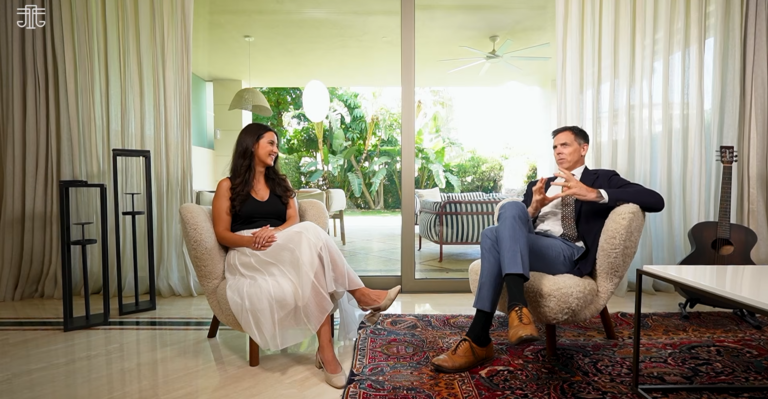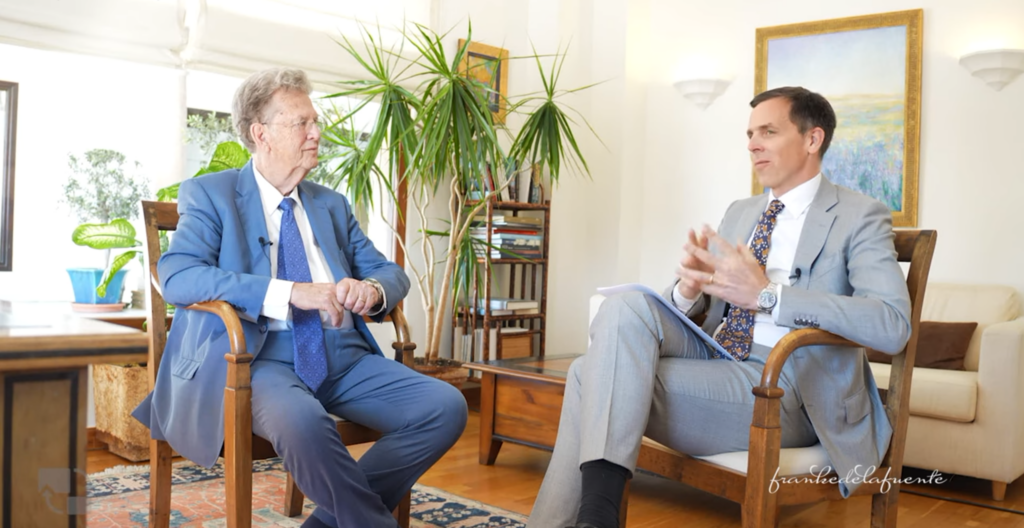
A conversation with Christopher Clover, President of Panorama Properties, hosted by Peter Franke, co-founder of Franke & de la Fuente
Few people alive today can claim to have shaped Marbella’s international identity from the inside. Christopher Clover is one of them. As the head of Panorama Properties — founded by his father in 1970 and now the longest-running estate agency on the Costa del Sol — Clover has watched Marbella evolve from a jet-set enclave into one of the world’s most recognised luxury addresses. In a wide-ranging conversation with Peter Franke, co-founder of the law firm Franke & de la Fuente, Clover shared his perspective on American buyers, the end of the Golden Visa, the transparency gap in Spanish real estate, and what it will take to protect Marbella’s future.
A Family Legacy, and a City’s Origin Story
When Christopher Clover’s father opened Panorama’s Marbella office in 1970, the Costa del Sol was already drawing the European elite — but it was far from the global destination it is today. The agency’s roots stretch back further still: Clover’s grandfather opened his first real estate office in Chicago in 1904 and was among the pioneer golf course developers in the United States. His father later built Clover Realty in Charlottesville, Virginia, and acquired an international property agency called Panorama, which ultimately led the family to Spain.
Today, Panorama holds a distinction that speaks for itself: “the longest established real estate agency in Marbella. We are the first international real estate agent in Marbella.”
— Christopher Clover, Panorama Properties
The company was also the first to bring charter flights of American clients to the Costa del Sol — at its peak, a single flight carried 120 people and resulted in 60 sales in a matter of days. That era did not last. By the mid-1970s, economic recession in the United States forced a pivot, and Panorama reinvented itself as a full local resale agency — a position it has held for over five decades. Today, with a team of around 30 people across two offices and a joint venture with the Puente Romano Hotel, the firm remains one of the most respected names on the coast.
Peter Franke, whose law firm regularly advises international buyers throughout the purchase process, noted the value of that institutional depth: “How lucky I am to be joined by Christopher Clover from Panorama. With his rich experience, we are hoping that we can also cover a few other topics — the history of Panorama, and a few points maybe on the future of Marbella.”
American Buyers: Visible Trend, Modest Numbers
The rise of American interest in the Marbella market has been a topic of conversation across the industry in recent years. Clover, himself American, brings a grounded perspective — and a critical eye for hype.
“there’s never been a mass market in America for Spain”
— Christopher Clover, Panorama Properties
The numbers bear this out. Of the approximately 582,000 properties sold in Spain in the most recent year tracked, foreign buyers represented just 15% of transactions — and Americans accounted for only around 1.5 to 2% of that foreign slice. Clover is candid: in absolute terms, the American market is statistically small. Yet at Panorama, the share is disproportionately high. “we had 6 sales to Americans, which is double the national average.”
— Christopher Clover, Panorama Properties
What is driving the uptick? Clover points to a structural shift in global wealth. “There’s more money today in private hands than ever before in the history of mankind” — and a growing cohort of Americans with both the means and the curiosity to consider a life, or at least a second home, beyond US borders. The appeal of Marbella is not difficult to explain: “The lifestyle that we have in Marbella and on the Costa del Sol in general with our 12-month season is absolutely incredible. It’s unique. In the whole Mediterranean coast.”
— Christopher Clover, Panorama Properties
Still, Clover is measured about the growth potential. Geography remains a structural constraint. European buyers can leave on a Friday morning and be on their Marbella terrace by afternoon. Americans cannot — a trip requires at least a week or two to be worthwhile, which fundamentally limits the frequency of visits and the pull toward ownership. The core market, he argues, will remain Western European, complemented by Middle Eastern buyers who tend to come for extended stays of a month or more each summer.
What American Buyers Expect — and What Surprises Them
For agents and legal advisors working with US clients for the first time, Clover offers an important framing: Americans arrive with a different set of expectations, shaped by one of the most regulated real estate markets in the world.
“Americans expect — they generally don’t jump from agent to agent to agent.”
— Christopher Clover, Panorama Properties
In the United States, buyers typically select one agency and expect it to represent them throughout the entire search. The concept of “my broker” carries real weight. This contrasts with practice on the Costa del Sol, where buyers frequently contact multiple agencies simultaneously. American clients also arrive familiar with a system of binding reservation contracts, mandatory equipment warranties, and clear title insurance requirements — protections that are embedded by law in the US transaction process.
In Spain, the landscape is different. Regulatory standards for agents are lower, and the role of the lawyer is correspondingly more prominent. As Clover puts it, “buyers are more beware, caveat emptor, and lawyers are protective. And this is as it should be.”
— Christopher Clover, Panorama Properties
Peter Franke, who advises international buyers through precisely this process, added that the differences extend to the deposit structure as well. In the US, professional third-party escrow agents are a standard feature of transactions. In Spain, deposits are typically held in a law firm’s client account — a system that functions well but requires meticulous documentation and a clear understanding of the obligations involved.
There are also positive surprises. Americans used to property taxes of 1.3% to 3% of property value per year — often the mechanism through which local schools are funded in the US — are consistently astonished by Spanish rates. As Peter Franke noted, when American clients hear about the local IBI (Impuesto sobre Bienes Inmuebles), the reaction is invariably one of relief.
The Golden Visa: Political Signal, Limited Market Impact
The Spanish government’s announcement that it intends to eliminate the Golden Visa programme was met with concern across the international property community. Peter Franke, who noted receiving multiple calls from existing and prospective clients in the days following the announcement, raised the question directly: would the change affect American buyers’ willingness to purchase?
Clover’s answer, on the American question specifically, was straightforward: no. American buyers have rarely relied on the Golden Visa as a motivation to buy. But his broader assessment of the policy decision was sharper.
“the uncertainty of having announced this before having thought it through” characterises the situation, he said — noting that as of the time of recording, it remained unclear whether the cancellation applied only to residential purchases or also to those who had invested over €1 million in Spanish government bonds. The Golden Visa represented only around 14,000 cases against a backdrop of nearly 600,000 annual property sales in Spain, of which foreigners account for 15%. In Clover’s words, it is “a drop in the bucket” in terms of market volume.
More fundamentally, Clover argues that the fundamental attractiveness of Andalucía as a destination for wealth is structural, not dependent on a single visa category. “If you want to come here and you want to become a resident here and you have enough money, you will be able to find your residency here one way or another.”
— Christopher Clover, Panorama Properties
Alternative pathways — the non-lucrative visa, the digital nomad visa, and others — remain available. And the tax environment in Andalucía continues to be among the most favourable in Spain, with no inheritance tax between close relatives, no gift tax in most cases, and the wealth tax abolished. As Peter Franke and Clover both observed, these structural advantages far outweigh the loss of a single immigration scheme for buyers who are genuinely committed to relocating or investing here.
The Transparency Problem: What the Market Still Lacks
One of the most pointed sections of the conversation concerned the absence of meaningful market data in Spain — a gap that puts both buyers and agents at a disadvantage and contributes to the persistent problem of overpricing.
“it’s disgraceful, the lack of statistics available for investors in this country”
— Christopher Clover, Panorama Properties
As honorary president of the LPA (Leading Property Agents of Spain), Clover has lobbied notaries, property registries, and the national statistics institute (INE) for access to anonymised transaction data — the kind of street-by-street, square-metre pricing that buyers in the US, Sweden, and other markets take for granted. The response has been bureaucratic deflection. The data exists. It is not made available.
This matters for international buyers. Without comparable sales data, it is genuinely difficult to assess whether an asking price reflects market value — and sellers’ agents face a temptation to overprice in order to win listings. Clover is unambiguous about the ethics of this practice: agents should base valuations on real, comparable sales and be able to demonstrate this to sellers, not inflate expectations to secure a mandate.
For international buyers working in this environment, independent legal advice is not just a safeguard — it is a structural necessity. The combination of limited price transparency, variable agent quality, and a legal framework that differs substantially from common-law systems makes professional guidance through the purchase process essential.
The Future of Marbella: Quality, Not Quantity
For Clover, the central question about Marbella’s future is not whether demand will continue — he is confident it will — but whether the destination can sustain the quality that has made it exceptional.
The evidence of Marbella’s ascent to global status is visible in the restaurant landscape alone: of the 23 Michelin-referenced restaurants in the province of Málaga, “11 of them are in Marbella.” Restaurant brands that operate in Dubai, Doha, Miami, London, and Monte Carlo have chosen Marbella as a location — a selection that reflects where the city now sits in the global hierarchy of luxury destinations.
“Marbella is a tiny place compared with these other places. That’s a statement.”
— Christopher Clover, Panorama Properties
The city now operates on a true 12-month season. Where once there was a marked low season, today “there’s an activity year-round in Marbella” — a shift that Clover attributes to the pandemic-era acceleration of remote working, the growth of the permanent international community, and the sheer volume of amenities that now make living here viable at any time of year. “The multiculturalism, it works here” — a point Clover makes with emphasis, noting that the integration of communities from across Europe, the Middle East, Latin America, and beyond has succeeded in Marbella in ways that have proved elusive elsewhere.
To sustain this, Clover calls for a disciplined and unglamorous commitment to public infrastructure: maintaining roads, beaches, and security; raising the standards of municipal services; ensuring that no part of the city falls into neglect. “Let no corner of Marbella be left abandoned. Fix every single road. Keep Marbella totally clean.”
— Christopher Clover, Panorama Properties
The goal, in his view, is not unbounded growth but disciplined excellence. “we have to keep the quality, highest quality possible anywhere. And that way we’ll be able to maintain standards and reasonable growth” — “not growth at any cost.”
— Christopher Clover, Panorama Properties
Peter Franke closed the conversation with a note of shared purpose: “Let’s see if Marbella can fulfil its destiny, put it like that, maybe.” Clover’s response was characteristically direct: “We’re all integral parts of this. It’s up to us to make it happen.”
This article is based on a podcast episode of The Country Files, hosted by Peter Franke, co-founder of Franke & de la Fuente. Franke & de la Fuente is a law firm specialising in real estate law and international property transactions on the Costa del Sol.