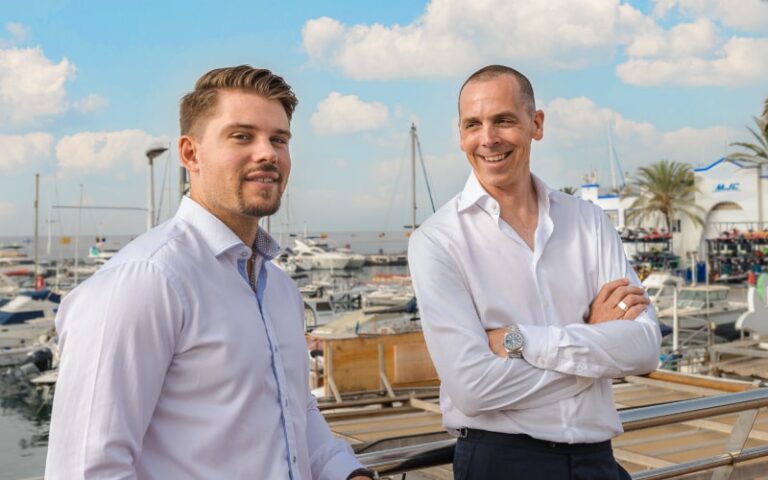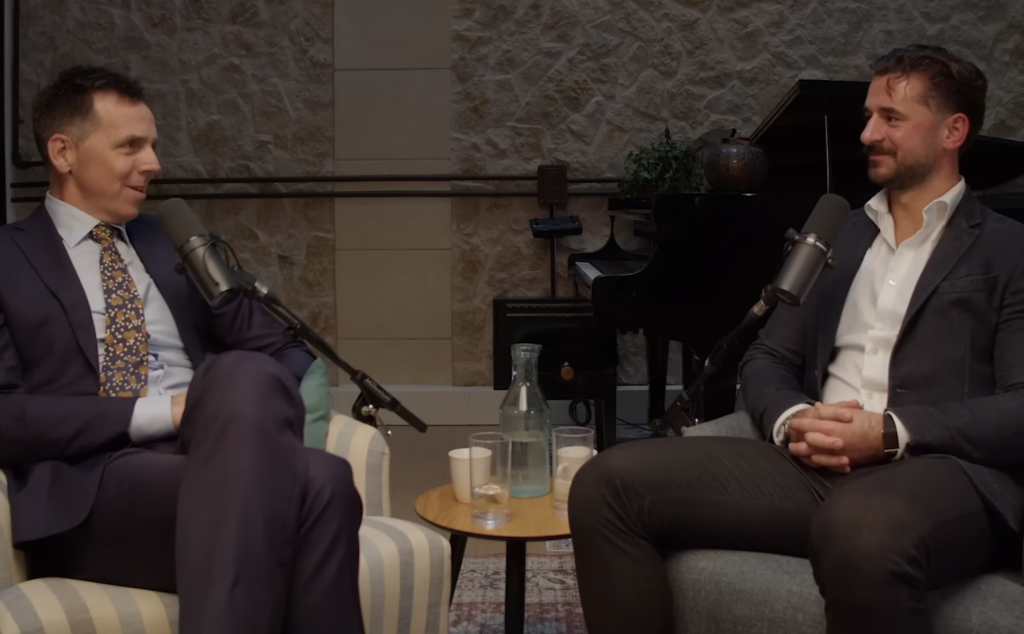
In the fifth episode of our podcast Behind the Sale, recorded here in Palma, we invited Rebuar from Sandberg Estates to share his perspective on Mallorca’s evolving property market, international buyers, and what the future holds for the island.
At Franke & de la Fuente, we work daily with international clients who are buying, selling, and relocating to Mallorca. We see first-hand how the market is changing — and how the legal and tax needs of our clients have become significantly more complex. That is precisely why we launched Behind the Sale: to take the conversations we already have with brokers, advisors, and industry experts here on the island and share them with a wider audience.
In this episode, we sit down with Rebuar, Sales Director at Sandberg Estates, one of Mallorca’s most established real estate agencies with offices in Palma and Portals. Rebuar, born in Freiburg to a German mother and Iranian father and educated in real estate economics in Berlin, relocated to Mallorca during COVID — a decision he says he has “not regretted for a day.”
A Market in Transition: From Holiday Homes to Permanent Relocation
One of the clearest trends we observe among our own clients at Franke & de la Fuente is that more and more people are not simply buying a holiday apartment in Mallorca — they are moving here permanently. It is something Rebuar recognises immediately from his work at Sandberg Estates.
He describes how buyers’ requirements change fundamentally once relocation becomes the goal. Those who previously sought a low-maintenance lock-up-and-leave property are now looking for something very different: “bigger plots, bigger houses, more bedrooms, more garden, suitable for kids, near to schools.”
“…more and more people actually moving here, relocating here completely” — buyers are now seeking year-round urban living, not just a seasonal escape.
— Rebuar, Sandberg Estates
The seasonal pattern has reversed entirely too. Where buyers once arrived for summer and left in autumn, Rebuar notes that most buyers today are trying to be here in the winter and “go away in the summer” — “so a complete switch” from how the market looked just a few years ago. Geographically, demand is also moving away from Andratx and the rural southwest towards Palma itself, where buyers prioritise city life, international schools, and year-round amenities.
Who Is Buying Property in Mallorca?
Sandberg Estates was founded 12 years ago by Cecilia and her son Michi and has grown organically to 11 agents and nine back-office staff. Their client base reflects well the breadth we also see among our own clients at Franke & de la Fuente.
German-speaking buyers — from Germany, Austria, and Switzerland — remain the dominant force in the market, estimated to account for around 50% of all international property purchases on the island. But the buyer profile is broadening considerably: “We have many Brits, more and more Eastern European, even some Americans as well,” Rebuar tells us.
He points to growing political and social instability in many buyers’ home countries as a key driver. “We’re a “safe haven,” let’s say. We’re an island and very good infrastructure.” It is a picture we recognise at Franke & de la Fuente — many of our clients cite stability and security as decisive factors in choosing Mallorca.
What International Buyers Need to Know About the Spanish Property Process
At Franke & de la Fuente, we guide international buyers through the Spanish property process every day — and we know it frequently surprises them. Rebuar describes it well:
“There’s no public record about prices or a public register” — and if you are new to the island, you need someone to “guide you through that process.”
— Rebuar, Sandberg Estates
In Germany, once a price is agreed the buyer goes directly to the notary. In Spain, the process works differently: buyers first “reserve the property with an arras,” a reservation deposit and preliminary contract, before a series of due diligence steps and the final notarial deed. Without proper legal representation at each stage, buyers risk overlooking critical details — from the property’s legal status and outstanding debts to planning regulations and tax implications.
This is also why our services at Franke & de la Fuente have expanded considerably. As Peter explains in the episode:
“Almost 50% of our clients” need more than just the property conveyance — they need tax advice, immigration support, and often help with corporate structuring.
— Peter, Franke & de la Fuente
This might mean understanding their Spanish tax residency position, whether the Beckham Law applies to them, whether to hold property personally or through a corporate structure, or how to continue running their business within a Spanish legal framework.
The Broker’s Evolving Role — and the Value of the Right Partnerships
Rebuar also highlights how the demands placed on real estate agents have shifted. Buyers today routinely ask questions that would traditionally fall within the remit of a lawyer or tax adviser:
“A broker, generally, has to be “more knowledgeable now.” It’s more of a “lifestyle advisory” almost.”
— Rebuar, Sandberg Estates
This is precisely why we at Franke & de la Fuente value our collaboration with experienced agencies like Sandberg Estates. When a buyer receives joined-up guidance — from property viewings through legal due diligence, tax planning, and corporate structuring — the entire process becomes safer and more straightforward for everyone involved.
The Housing Affordability Challenge and the Path Forward
The conversation also addresses the tensions that sustained international demand creates locally. Rebuar is candid that the solution lies at a political level:
“I think “the solution is politically.” There are laws that prevent owners from renting out their properties — if those were addressed, it would bring more inventory to market and help balance prices across the Balearics.”
— Rebuar, Sandberg Estates
He points to an estimated 100,000 empty units across the Balearic Islands and draws on the German model of subsidised lending for social housing development as a framework Spain could look to adopt. Reducing bureaucracy around building permits and releasing more residential land would, in his view, ease the pressure substantially.
Outlook: Palma as a Long-Term Destination
Our view at Franke & de la Fuente — shared by Rebuar — is that Palma’s appeal to international buyers is structural, not cyclical. The island offers a rare combination: Mediterranean climate, strong infrastructure, European legal frameworks, excellent international schools, and easy access to major European capitals.
As geopolitical uncertainty grows across parts of Europe and beyond, the case for a stable, well-connected island community only strengthens. The challenge ahead is not demand — it is balance, and finding the policy tools to ensure that international investment and local housing needs can coexist sustainably over the long term.
Behind the Sale is a podcast produced by Franke & de la Fuente, an international law firm based in Palma de Mallorca, Marbella, Estepona and Fuengirola, specialising in property law, taxation, immigration, and corporate legal services for international clients. Episodes are recorded here in Palma with leading brokers and advisors on the island.